About Orthodoxy
The Living Church of Christ
The Orthodox Church is the living manifestation of Christ's presence in the history of mankind — faithful to the apostolic tradition and rich in its liturgical life.
For nearly two thousand years, through every age and across every continent, she has preserved the fullness of the Christian faith once delivered to the saints.
“… and the disciples were first called Christians in Antioch.”
Two Thousand Years
One Church, Unchanged
From the day of Pentecost to the present, the Orthodox Church has held the same faith. As the centuries passed, the Christian West divided again and again — yet the ancient Church has continued, undivided and unchanged.
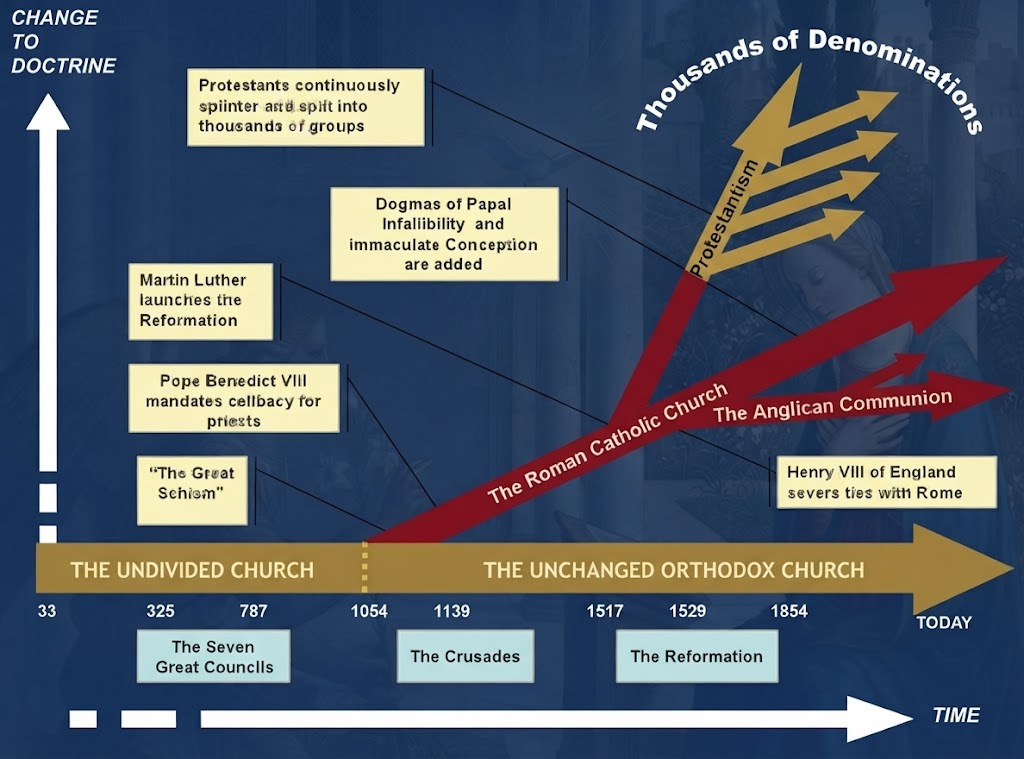
An Introduction
What Is the Orthodox Church?
To understand Orthodoxy is to look back to the undivided Church of the first Christian centuries — and to find that same faith alive and worshiping today. What follows is a brief introduction to her origins, her structure, her history, and the beauty of her worship.
Her Origins
The Church of the Apostles
The Orthodox Church was founded by our Lord Jesus Christ and is the living manifestation of His presence in the history of mankind. Its most conspicuous characteristics are its rich liturgical life and its faithfulness to the apostolic tradition.
Orthodox Christians believe that their Church has preserved the tradition and continuity of the ancient Church in its fullness, compared to other Christian confessions which have departed from the common tradition of the Church of the first ten centuries. Today the Orthodox Church numbers approximately 300 million Christians who follow the faith and practices defined by the first seven Ecumenical Councils.
The word orthodox — “right belief and right glory” — has traditionally been used to designate the communities and individuals who preserved the true faith as defined by those councils. The official designation of the Church in its liturgical and canonical texts is “the Orthodox Catholic Church,” catholicos meaning universal.
Her Structure
A Family of Churches
The Orthodox Church is a family of autocephalous — self-governing — churches, with the Ecumenical Patriarch of Constantinople holding titular or honorary primacy as primus inter pares, the first among equals. It is not a centralized organization headed by a single pontiff. Its unity is manifested instead in a common faith and communion in the sacraments, and no one but Christ Himself is the real head of the Church.
Today these autocephalous churches include Constantinople, Alexandria, Antioch, Jerusalem, Russia, Serbia, Romania, Bulgaria, Georgia, Cyprus, Greece, Poland, the Czech Lands and Slovakia, Albania, and America. There are also autonomous churches in Sinai, Crete, Finland, Japan, China, and Ukraine, alongside a large Orthodox diaspora scattered throughout the world.
The order of precedence in which these churches are listed does not reflect their actual size or influence. Constantinople's primacy of honor, recognized by the ancient canons, remains a symbol and instrument of church unity and cooperation — for all bishops are completely equal in the power granted to them by the Holy Spirit.
Her Mystery
The Body of Christ
In the wider theological sense, Orthodoxy is not merely an earthly organization headed by patriarchs, bishops, and priests. Orthodoxy is the mystical Body of Christ, the Head of which is Christ Himself.
Its membership includes not only the clergy but all who truly believe in Christ and have entered into the Church He founded — those living upon the earth and those who have died in the Faith and in piety. It is a communion that spans heaven and earth, the living and the departed, gathered as one in Him.
Her History
The Great Schism
The Great Schism between the Eastern and Western Church in 1054 was the culmination of a gradual estrangement that began in the first Christian centuries and continued through the Middle Ages. Linguistic and cultural differences, as well as political events, all contributed to the growing separation.
From the 4th to the 11th century, Constantinople was both the center of Eastern Christianity and the capital of the Byzantine Empire, while Rome fell under the influence of the Holy Roman Empire of the West. In the West, theology remained under the influence of St. Augustine of Hippo and gradually lost immediate contact with the rich theological tradition of the Christian East.
The deepest difference lay in two concepts of church authority. The growth of Roman primacy — claiming jurisdictional authority over other churches — was incompatible with the traditional Orthodox understanding, in which all churches are sister churches and the Roman bishop is honored as primus inter pares among his brother bishops.
Her Reach
Present Throughout the World
At the time of the Schism, the membership of the Orthodox Church was spread throughout the Middle East, the Balkans, and Russia, with its center in Constantinople — New Rome, the capital of the Byzantine Empire. Even today, the bulk of its members live in the same geographic areas.
Missionary expansion toward Asia and emigration toward the West have helped to spread the presence of Orthodoxy worldwide. The Orthodox Church is now present almost everywhere on earth, bearing witness to the true, apostolic, and patristic tradition among all peoples.
The Church is also well known for its developed monasticism. Its uninterrupted monastic tradition can be traced from the Egyptian desert monasteries of the 3rd and 4th centuries, spreading through Palestine, Syria, Cappadocia, Gaul, Ireland, Italy, Greece, and the Slavic lands. Monasticism has always been a beacon of Orthodoxy and continues to shape its spirituality.
Her Worship
Heaven on Earth
The Orthodox Church is an invaluable treasury of the rich liturgical tradition handed down from the earliest centuries of Christianity. The sense of the sacred, and the beauty and grandeur of the Divine Liturgy, make the presence of heaven on earth vivid and intense.
Orthodox art and music serve a deeply functional role in liturgical life, helping even the bodily senses to perceive the spiritual grandeur of the Lord's mysteries. Holy icons are not simply beautiful works of art with aesthetic and didactic functions — they are primarily the means through which we experience the reality of the Heavenly Kingdom on earth.
The holy icons enshrine the immeasurable depth of the mystery of Christ's Incarnation, and in venerating them the faithful lift their hearts to the One they depict.
Excerpt taken and adapted by the Orthodox Christian Information Center from The Orthodox Church by Bishop Kallistos (Ware).
We Invite You
The surest way to know the Orthodox Church is to worship with her. Come and experience the beauty of ancient Christian worship, and discover the Church that has preserved the Apostolic Faith for nearly two thousand years.
“Come and see.” — John 1:46